|
|
 |
1:
Papillary Urothelial Carcinoma of Renal Pelvis
 |
 |
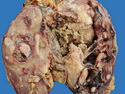
Comments: A papillary tumor is visible in the center of this gross photo. Tobacco use, exposure to industrial carcinogens, and phenacetin nephropathy are some of the important etiologic factors.
|
|
|
 |
|
 |
|
 |
3:
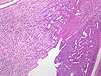
Papillary Urothelial Carcinoma of Renal Pelvis
 |
 |
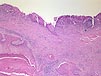
Comments: The histologic spectrum of papillary urothelial tumors arising in the upper urinary tract is similar to those seen in the bladder. This image shows low-grade papillary urothelial carcinoma.
|
|
|
 |
|
 |
4:
Angiomyolipoma : Gross morphology
 |
 |
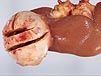
Comments: This gross photograph shows angiomyolipoma arising in the superior pole of right kidney. About 50% of the cases are associated with tuberous sclerosis. The rest occur sporadically. Tuberous sclerosis-associated tumors tend to be multiple, bilateral, and small & are usually asymptomatic.
|
|
|
 |
|
 |
5:
Angiomyolipoma
 |
 |
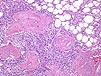
Comments: Microscopically, angiomyolipomas are composed of variable amounts of adipose tissue, smooth muscle, and thick-walled blood vessels.
|
|
|
 |
|
 |
6:
Angiomyolipoma
 |
 |
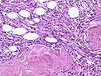
Comments: The smooth muscle bundles are often seen arising from the vessel wall. The blood vessels are thick-walled with small abnormal or abortive lumens. Cytologic atypia may be prominent. The smooth muscle cells react with HMB-45.
|
|
|
 |
|
 |
7:
Angiomyolipoma
 |
 |
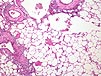
Comments: Adipose tissue and a few abnormal-looking blood vessels are seen in this example of angiomyolipoma. Smooth muscle component is inconspicuous in this field.
|
|
|
 |
|
 |
8:
Juxtaglomerular Cell Tumor
 |
 |
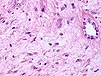
Comments: Juxtaglomerular Cell Tumor is a rare renal tumor presenting in young adulthood with severe hypertension due to excessive renin secretion, that is corrected by surgical removal of the tumor. Histologically, it resembles hemangiopericytoma and glomus tumors.
|
|
|
 |
|
 |
9:
Juxtaglomerular Cell Tumor
 |
 |
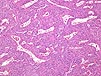
Comments: It consists of round or polygonal tumor cells arranged in sheets or trabeculae punctuated by a network of delicate vessels. The stroma contains chronic inflammatory cells with a prominent component of mast cells.
|
|
|
 |
|
 |
10:
Juxtaglomerular Cell Tumor
 |
 |
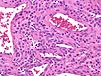
Comments: The tumor cells have uniform vesicular nuclei with evenly distributed chromatin, and occasional small nucleoli. In rare cases, mild nuclear pleomorphism, prominent nucleoli and mitotic figures may be seen. Demonstration of rhomboid protogranules by electron microscopy is diagnostic. Biologic behavior is benign with no recurrence or metastases.
|
|
|
 |
|
 |
|
 |
12:
Glomangioma in Kidney
 |
 |
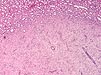
Comments: Glomus-like tumors may rarely arise in the kidneys. In this illustration, the tumor is located in the renal pelvis and can be seen in the bottom right of the image.
|
|
|
 |
|
 |
13:
Glomangioma in Kidney
 |
 |
Comments: Sheets of monomorphic cells fill the space between vascular channels. Many vessels have “staghorn” configuration resembling those seen in hemangiopericytoma. Sometimes the term Glomangiopericytoma is applied to such tumors.
|
|
|
 |
|
 |
14:
Glomangioma in Kidney
 |
 |
Comments: The tumor cells appear to be arising from the vessel walls. They have round to oval nuclei with inconspicuous nucleoli. There is slight spindling of some of the glomus cells.
|
|
|
 |
|
 |
|
 |
|
 |
17:
Renal Carcinoid
 |
 |
Comments: Primary renal carcinoid is a extremely rare tumor and is over-represented in patients with horseshoe kidney and other congenital developmental renal defects (J Urol 1997 June; 157(6)2059-66). This illustration shows the typical morphology of a carcinoid tumor.
|
|
|
 |
|
 |
18:
Renal Carcinoid
 |
 |
Comments: The tumor cells are arranged in ribbons separated by sclerotic stroma.
|
|
|
 |
|
 |
19:
Renal Carcinoid
 |
 |
Comments: The nuclei are monomorphic with inconspicuous nucleoli. The nuclear chromatin has somewhat granular appearance. Mitotic activity is not increased. (same case as previous 2 illustrations).
|
|
|
 |
|
 |
20:
Primitive Neuroectodermal Tumor
 |
 |
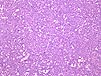
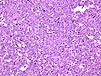
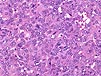
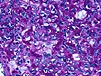
Comments: PNET is an exceedingly rare primary tumor in the kidney which has to be distinguished from blastema-predominant Wilms tumor. This photomicrograph show sheet-like growth of primitive round cells.
|
|
|
 |
|
 |
21:
Primitive Neuroectodermal Tumor
 |
 |
Comments: A focus of vascular invasion is shown. Lung metastases are common in this aggressive tumor. About 90% of cases of Ewing’s Sarcoma / PNET have a specific translocation t(11;22) resulting in a EWS-FLI-1 chimeric protein.
|
|
|
 |
|
 |
22:
Primitive Neuroectodermal Tumor
 |
 |
Comments: This case of PNET arising in the kidney shows prominent rosette formation. PNET usually shows immunoreactivity for CD99, FLI-1 (carboxy terminus of FLI-1 fusion protein) and are negative for WT-1. Am J Surg Pathol 2002 March; 26(3):320-7.
|
|
|
 |
|
 |
23:
Granulocytic Sarcoma in Kidney : Gross morphology
 |
 |
Comments: Granulocytic sarcoma (also previously known as Chloroma) refers to tumor-like lesions of extramedullary myeloid leukemia. They have characteristic green color on cut surface due to myeloperoxidase– as illustrated in this case – which fades on standing. Immunoreactivity for chloroacetate esterase and myeloperoxidase is diagnostic.
|
|
|
 |
|
 |
24:
Lymphoma in Kidney
 |
 |
Comments: Lymphoma initially presented as a renal mass in this case. The interstitium is completely replaced by atypical lymphoid cells with sparing of the glomeruli. Secondary involvement of kidney occurs in approximately 50% of cases of disseminated malignant lymphoma.
|
|
|
 |
|
 |
25:
Lymphoma in Kidney
 |
 |
Comments: When presenting as a primary renal mass, lymphomas tend to be large cell type (seen here). Small cell lymphomas, Hodgkin’s disease, and plasmacytoma are also rarely seen
|
|
|
 |
|
 |
26:
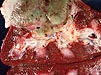
Kidney : Squamous Cell Carcinoma
 |
 |
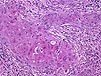
Comments: Squamous cell carcinoma of the renal pelvis is an uncommon tumor that is associated with calculi, chronic infection and perhaps with horseshoe kidney. This image shows squamous metaplasia of the lining of the renal pelvis with broad tongues of squamous epithelium infiltrating underneath.
|
|
|
 |
|