Genitourinary Tract

Genitourinary Tract

   Home | About this Site | Feedback | Site Map
Friday, September 10, 2010               
 
 Infertility
  Back to Testes | Return to Genitourinary Tract
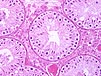
1: Testes : Maturation Arrest
Comments: This testicular biopsy done for infertility workup in a young male shows maturation arrest. There are numerous spermatogonia (adjoining the basement membrane), few spermatocytes and no mature spermatozoa.
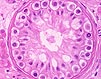
2: Testes : Maturation Arrest
Comments: The cells present on the luminal aspect of the tubule are Sertoli cells. This appearance can be produced by the same agents that can induce hypospermatogenesis, such as radiation, alkylating agents, gonadotropin deficiency. When complete maturation arrest is diffusely present bilaterally, the sperm count is usually zero.
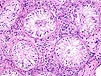
3: Sertoli-cell-only Syndrome (Germ Cell Aplasia)
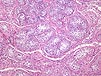
Comments: This testicular biopsy is from a patient with normal semen volume and azoospermia. It His FSH level was elevated. The biopsy shows seminiferous tubules lined only by mature Sertoli cells. The term “wind-swept appearance” has been used to describe sertoli cells in this condition.
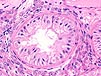
4: Sertoli-cell-only Syndrome (Germ Cell Aplasia)
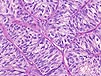
Comments: The sertoli cells have oval nuclei and punctate nucleoli. Leydig cells are usually normal in appearance but may appear to be increased in number due to reduced tubular diameter. Causes of Sertoli cell-only syndrome include: gonadotropin deficiency, cryptorchidism, viral orchitis, irradiation, alkylating agents, hormonal therapy for prostate cancer etc.
5: Testes : Klinefelter's Syndrome (47 XXY)
Comments: This testicular biopsy is from an adult male with history of normal semen volume and severe oligospermia. He had small firm testes and body habitus suggestive of Klinefelter’s syndrome. The biopsy shows small hyalinized seminiferous tubules and pseudo-adenomatous clusters of leydig cells.
6: Testes : Klinefelter's Syndrome (47 XXY)
Comments: Atrophy of seminiferous tubules and reduced testicular volume gives a false impression of leydig cell hyperplasia in Klinefelter’s syndrome. Studies have shown that the total number of leydig cells is actually reduced.
7: Testes : Klinefelter's Syndrome (47XXY)
Comments: Couple of hyalinized seminiferous tubules surrounded by leydig cells containing abundant microvacuolated cytoplasm. Even though leydig cells may appear morphologically normal in Klinefelter’s syndrome, they are often functionally deficient and androgen levels are often reduced accompanied by elevated FSH and LH levels.
8: Testicular Feminization (Androgen Insensitivity Syndrome)
Comments: A form of male pseudohermaphroditism with female phenotype and presence of testes. Karyotype is usually XY; but XXY may be seen. Seminiferous tubules have small abortive lumens and usually contain only sertoli cells. About 10% of patients with testicular feminization develop testicular cancers.
9: Testicular Feminization (Androgen Insensitivity Syndrome)
Comments: Note the absence of lumens and presence of only sertoli cells in the seminiferous tubules. Numerous leydig cells are seen. Leydig cells in testicular feminization syndrome often lack Reinke’s crystalloids.
10: Pick's Adenoma in Cryptorchidism
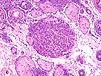
Comments: Post-pubertal cryptorchid testis showing small sclerotic tubules with thickened tunica propria and interstitial fibrosis. Such testes often show nodules of small tubules lined by sertoli cells (seen in the center of the photomicrograph) referred to as Pick’s adenoma. These are not true neoplasms.
11: Pick's Adenoma in Cryptorchidism
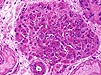
Comments: High power view of Pick’s adenoma reveals sertoli cells with hyperchromatic nuclei lined perpendicular to the basement membrane.
12: Ovotestes in True Hermaphroditism
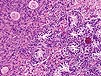
Comments: In true hermaphroditism (characterized by the presence of both testicular and ovarian tissue), ovotestis is the most common gonad type. In this example, three ovarian follicles are seen on the left and numerous small seminiferous tubules with immature sertoli cells are seen on the right.
13: Ovotestes in True Hermaphroditism
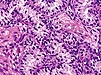
Comments: In ovotestis, the seminiferous tubules remain small and rarely may show incomplete spermatogenesis. This illustration shows hyperchromatic sertoli cells lining the tubules. Such dysgenetic gonads are prone to develop tumors, including gonadoblastoma, dysgerminoma, and yolk sac tumor.
14: Ovotestes in True Hermaphroditism
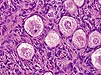
Comments: The ovarian follicles in ovotestis often mature to corpus luteum in adulthood. Some hermaphrodite patients raised as females have even become mothers.
15: Testicular Regression Syndrome
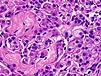
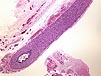
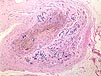
Comments: This left testicular remnant removed from a 3 year-old boy shows intact vas deferens and some fibroconnective tissue. He had presented with absent left testis and compensatory hypertrophy of the right testis (Monorchidism).
16: Testicular Regression Syndrome
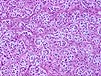
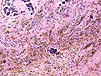
Comments: The image shows a vascularized fibrous nodule with areas of hemosiderin deposition and dystrophic calcification. The presence of vas deferens (seen in the previous image) is the most consistent finding. S E Spires et al. Testicular Regression Syndrome. Arch Pathol Lab Med. 2000; 124:694-698.
17: Testicular Regression Syndrome
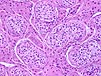
Comments: Besides hemosiderin and dystrophic calcification, arterious and venous vessels, adipose tissue, and nerves may be present in the testicular remnant. Most cases of monorchidism result from a vascular lesion or intrauterine torsion compromising circulation in the developing gonads.
Last Updated: Tuesday, August 03, 2010
 
SLIDE INDEX
Brain
Head & Neck
Mediastinum
Lungs Pleura
Lymph Nodes Spleen
Heart Blood Vessels
Gastrointestinal Tract
Female Genital Tract
Genitourinary Tract
Prostate
Urinary Bladder
Kidney
External Genitalia
Testes
Adrenal
Bone & Cartilage
Soft Tissue
Peritoneum
Endocrine
Breast
Skin
 
SEARCH  
twitter